 Microsoft has closed the door on one of the most widely used tricks for activating Windows 11 without paying for it. The company pushed out new security updates this month that permanently disable a set of PowerShell scripts known as MAS, short for Microsoft Activation Scripts. The tools, created by a group called Massgrave, had been circulating on GitHub for years and gave users a quick way to unlock Windows or Office without a valid license. [Read more…]
Windows 10 Is Dead. Long Live Windows 10!
 After nearly a decade, Microsoft is finally closing the book on Windows 10. As of today, free support and regular security patches have officially ended. But despite the headlines, your computer is not about to implode. If you plan wisely, or even just use decent security software, you can keep running Windows 10 safely for a quite a bit longer. [Read more…]
Microsoft Retires the Blue Screen of Death, Because Apparently Black Is More Soothing
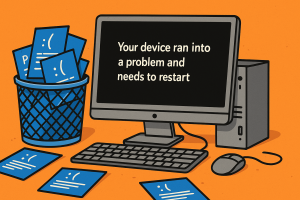 After 40 years of glaring blue error messages and frowny faces, Microsoft is giving the infamous Blue Screen of Death a final sendoff. Starting later this summer, Windows 11 devices will crash in a new color. Say hello to the Black Screen of Death.
The change isn’t just about ditching the old aesthetic. Microsoft says the new screen will simplify crash messages and speed up recovery. Gone is the sad face emoticon. In its place is a stripped-down message with technical details like the stop code and system driver that triggered the failure. The goal is to help users recover faster and give IT teams what they need without dragging them into a full-blown forensic session. [Read more…]
Microsoft Plugs One Secure Boot Flaw While Leaving Another Wide Open
 Security researchers have identified two major exploits in the Secure Boot system, both capable of sidestepping one of the most important protections on modern PCs. Microsoft has issued a patch for one of them. The other remains untouched, even as it offers attackers a nearly universal method to bypass security during the startup process.
This week’s patch from Microsoft addresses a vulnerability known as CVE-2025-3052. It impacts over 50 manufacturers whose systems rely on Linux modules to support boot processes. The flaw allows someone with physical access to a device to disable Secure Boot entirely. Once that’s done, they can install malware that loads before the operating system starts. The attack is particularly concerning because it’s stealthy and persistent, and in cases where a hacker already has administrative access, it can be triggered remotely. [Read more…]
Microsoft Extends Office Security Updates on Windows 10 Through 2028
 Microsoft will continue rolling out security updates for Microsoft 365 apps on Windows 10 until October 2028, extending support three years past the operating system’s planned end-of-life.
The change follows the company’s earlier position, announced in January, that Office apps would stop receiving updates on Windows 10 starting in October 2025. At the time, Microsoft urged users to upgrade to Windows 11 to maintain access to updated versions of Word, Excel, and other Microsoft 365 tools.
