Wi-Fi has become the invisible wiring of modern life. Billions of devices rely on it every day, from phones and laptops to smart TVs and industrial systems. That scale has always made wireless security a high-stakes problem. Now new research shows that a fundamental protection built into nearly every router can be quietly bypassed, allowing attackers on the same network to intercept and tamper with traffic that was supposed to be isolated and protected.
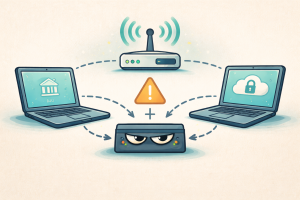
The newly disclosed technique, called AirSnitch, does not crack encryption in the traditional sense. It does not rely on breaking WPA2 or WPA3 the way earlier attacks shattered WEP years ago. Instead, it targets how Wi-Fi networks handle identity at the lowest levels of communication. By manipulating the way access points map devices to internal network ports, an attacker can redirect traffic flowing to and from a victim, effectively placing themselves in the middle of the conversation.
Client isolation is the safeguard at the heart of this issue. Router makers promote it as a way to prevent one connected device from directly communicating with another. It is especially important on guest networks in homes, offices, hotels, and campuses. The assumption is simple: even if someone else joins the same Wi-Fi network, they cannot snoop on your traffic. AirSnitch challenges that assumption.
The attack takes advantage of how wireless access points associate devices with MAC addresses and how those mappings shift as devices connect and reconnect. By carefully forcing changes at the physical and data link layers of the network stack, an attacker can hijack the mapping that routes traffic to a specific device. Once that mapping points to the attacker’s hardware, traffic intended for the victim flows to the attacker first. With additional steps, the attacker can restore the mapping so the victim remains online and unaware, while the interception continues in both directions.
That bidirectional control is what makes AirSnitch stand out. Earlier Wi-Fi exploits often focused on injecting traffic or forcing deauthentication. AirSnitch enables full machine-in-the-middle capability under the right conditions. If a target visits websites that are not protected by HTTPS, the attacker can read and alter content in plain text. Login credentials, session cookies, payment information, and internal corporate data can all be exposed. Even when HTTPS is used, attackers can still tamper with DNS lookups, poison caches, or exploit unpatched vulnerabilities while observing traffic patterns.
The research shows that the weakness spans a wide range of consumer and enterprise hardware. Devices from vendors such as Netgear, TP-Link, ASUS, Ubiquiti, Cisco, D-Link, and others were tested, along with routers running popular open source firmware. Each tested product was vulnerable to at least one variation of the attack. In enterprise environments, the problem can extend across multiple access points that share a common wired distribution system. That means devices connected to different SSIDs on separate access points may still be exposed if the infrastructure behind them is shared.
One particularly troubling scenario involves centralized authentication systems. Under certain conditions, an attacker can intercept RADIUS traffic used in enterprise Wi-Fi deployments. That opens the door to credential theft and even the creation of rogue access points that appear legitimate to users. At that point, the attacker’s position on the network becomes deeply entrenched.
Still, the threat is not identical to past Wi-Fi disasters. AirSnitch requires the attacker to have some level of network access. It is not a drive-by exploit that anyone within radio range can execute without credentials. In a well secured home network with a strong password that is not shared broadly, the attack surface is narrower. The risk grows in environments where guest networks, shared infrastructure, or loosely controlled credentials are common.
Public Wi-Fi remains the most obvious danger zone. Coffee shops, airports, hotels, and conference centers already present opportunities for so-called evil twin attacks, where a rogue access point impersonates a legitimate one. AirSnitch adds another layer of exposure by undermining isolation within legitimate networks. That makes caution on shared Wi-Fi even more important.
Mitigations are limited for now. Some vendors have issued firmware updates to blunt parts of the attack, but deeper fixes may require changes in the wireless chipsets themselves. Client isolation mechanisms are not standardized across the industry, which complicates coordinated defense. Firewalls offer only partial relief because the weakness sits below the IP layer they primarily inspect.
Virtual private networks can reduce the risk by encrypting traffic between the device and a trusted endpoint, but they are not a cure-all. Metadata leakage and DNS exposure can still occur depending on configuration. For organizations with the resources, a zero trust approach that treats every device on a network as potentially hostile provides stronger containment, though that model remains complex to deploy.
AirSnitch does not mean Wi-Fi is suddenly unusable. It does mean the assumption that encryption alone guarantees isolation is no longer safe. Wireless networks have always balanced convenience and exposure. This discovery tilts that balance again, reminding users and administrators that even mature technologies can hide fragile foundations.
