 We’ve spent the last few years watching language models get disturbingly good at sounding smart. They write coherent essays, debug code, explain quantum physics in simple terms. The experience is convincing enough that serious people have started talking about these systems as if they’re on the cusp of real intelligence, or already past it.
They’re not. And the gap matters more than the hype suggests.
Look, I get the appeal. When ChatGPT solves a tricky programming problem or writes a passable legal brief, it feels intelligent. But fluency isn’t understanding, and being really good at predicting the next word isn’t the same as knowing how the world actually works.
What AGI Actually Means
Artificial general intelligence (real AGI) means a system that can learn across different domains, adapt when things change, and tackle problems it’s never encountered before. Humans do this constantly without thinking about it. You wake up to find your coffee maker broken, so you improvise with a French press. Your usual route to work is blocked, so you take side streets. You read about a new scientific finding and update your understanding of how something works.
All of this requires an internal model of reality. Not a perfect one (humans are wrong all the time) but a working sense of cause and effect. If I do X, Y will probably happen. If conditions change to Z, I should try something else.
Language models don’t have this. What they have is an incredibly sophisticated pattern matcher trained on billions of pages of human text. That training teaches them what kinds of words tend to follow other words, what concepts usually appear together, how people typically structure arguments. It’s powerful, but it’s fundamentally about correlation, not causation.
Where the Cracks Show
The limitations become obvious once you push these systems outside their comfort zone. Give a language model a physics problem with slightly unusual constraints, or ask it to reason through a scenario where normal assumptions don’t hold, and watch what happens. It doesn’t say “I don’t know.” It doesn’t recognize that it’s left the map. It just keeps going, generating plausible-sounding nonsense with the same confidence it had a minute ago, this is commonly referred to as a hallucination.
Judea Pearl (who literally won the Turing Award for his work on causal reasoning) has been making this point for years. Modern ML systems, he argues, mostly operate at what he calls the “association” level. They’re brilliant at spotting patterns in data. But ask them “what would happen if I changed this variable?” and they fall apart. That kind of inaccurate reasoning is something humans do spontaneously. It’s baked into how we think about the world.
Without it, you don’t have intelligence in any meaningful sense. You have a very advanced autocomplete.
What Actually Might Work
This is why the cutting edge of AGI research has moved beyond just making language models bigger. Scale helps. GPT-5 is clearly better than GPT-4, and whatever comes next will probably be better still. But it’s not a path to general intelligence. It’s a path to a really, really good statistical model of human text.
The researchers actually trying to build AGI are working on something different. Yann LeCun has been arguing for years that real intelligence requires learning abstract representations of how the world works, then using those representations to plan and predict. DeepMind has shifted focus toward training agents in simulated environments where they can act, see what happens, and learn from the consequences. Fei-Fei Li talks about “spatial intelligence” (the ability to understand objects, movement, physical relationships) as a fundamental piece that language models completely lack.
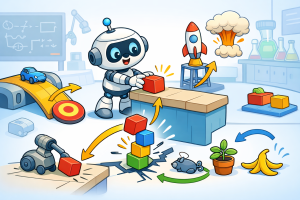
These approaches differ in the details, but they share a core insight: you can’t learn how the world works just by reading about it. You need interaction. Feedback loops. The ability to form a hypothesis, test it, and update your model based on what actually happens.
Why This Matters
None of this means language models are useless. They’re extraordinary tools. I use them constantly. They’ve changed how I write code, explore ideas, and work through problems. In the context of a larger system, they could serve as a crucial interface layer: the part that translates between human language and whatever internal representations an AGI actually uses.
But they’re not AGI, and treating them as if they are (or as if they’re almost there) creates real problems. It encourages sloppy thinking. It leads to overconfidence in deployment. It makes people assume these systems understand what they’re doing, when really they’re just very good at mimicking understanding.
That gap becomes dangerous once you start relying on these systems for high-stakes decisions. A model that sounds authoritative but lacks any actual model of reality can cause serious damage while seeming perfectly reasonable the whole time.
What the Path Forward Actually Looks Like
If we do eventually build AGI (and that’s still a big if), it won’t look like a scaled-up chatbot. It’ll be an architecture, probably a complex one, that combines multiple capabilities:
- Perception systems that ground abstract concepts in sensory reality
- Memory that persists and updates over time
- A world model that supports basic causal reasoning
- Planning mechanisms that can evaluate options and predict consequences
- Learning systems that improve through interaction, not just passive training
Language would still be part of this. Maybe a crucial part. But it would be one component among several, not the whole thing.
The fundamental issue with the “just scale language models” approach is that it mistakes correlation for causation at a philosophical level. Bigger models get better at predicting text. That’s not the same as understanding the underlying reality that generated that text. And no amount of scale changes that basic limitation.
Intelligence emerges from feedback loops: act, observe, adjust, repeat. Without that cycle, you’re just building increasingly sophisticated pattern matchers. Impressive ones, sure. But not intelligent ones.
The Bottom Line
We’re not close to AGI. We’ve built something remarkable and useful, but it’s not the thing we keep claiming it is. Language models are a tool, an important one, maybe even an essential stepping stone. But they’re not minds. They don’t understand the world. They predict text.
The sooner we’re honest about that distinction, the better our chances of actually building systems that do understand, and the less likely we are to deploy systems that sound smart but don’t know what they’re talking about into situations where that confusion could matter.
Real AGI, if and when it arrives, will be able to surprise us by learning something genuinely new, then explain its reasoning in terms grounded in how the world actually works. We’ll know it when we see it.
We haven’t seen it yet.
