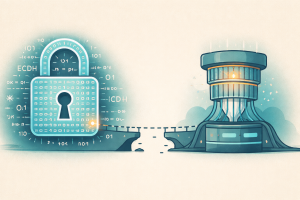
 For decades, modern encryption has rested on a simple assumption. Some math problems take so long to solve that no practical computer can crack them in a useful timeframe. That assumption built online banking, secure email, VPN tunnels, software signing, and almost every digital transaction that powers business and government today.
Quantum computing threatens to tear that assumption apart.
Unlike today’s computers, which process information in bits that exist as either zero or one, quantum computers rely on qubits that can exist in multiple states at once. That property allows them to attack certain mathematical problems at speeds no conventional system can match. The most concerning target is public key cryptography, the backbone of secure communications. Algorithms such as RSA and elliptic curve cryptography depend on the difficulty of factoring large numbers or solving discrete logarithms. A sufficiently capable quantum computer could do both far faster than anything available today.
No one has built a machine powerful enough to shatter modern encryption at scale. Yet the timeline matters less than many think. Attackers do not need quantum hardware today to pose a threat tomorrow. They can intercept encrypted data now, store it, and wait. Once quantum capability matures, they decrypt archives at will. This store now, decrypt later tactic has become a real concern in intelligence circles and enterprise security teams.
That fear has pushed governments and security researchers into a quiet race to harden cryptography before quantum systems reach maturity. The focus is not on patching old algorithms. It is on replacing them entirely.
The U.S. National Institute of Standards and Technology has led the charge. In 2022, NIST announced its first group of quantum resistant cryptographic algorithms after years of public competition and testing. The selection process examined dozens of candidates built around mathematical problems believed to resist quantum attacks. These included lattice based schemes, hash based signatures, and code based cryptography. The result marked a turning point. Quantum resistance moved from theory to standardization.
Adopting new algorithms across the digital world will not happen overnight. Encryption touches everything. Web servers use TLS certificates. Enterprises rely on VPN tunnels and secure email gateways. Code signing protects operating systems and firmware. Cloud providers secure storage and internal service communication with layers of cryptography. Replacing algorithms means updating software libraries, hardware security modules, authentication systems, and sometimes even embedded devices that cannot be easily patched.
Crypto agility has become the new buzz inside security teams. It refers to the ability to swap cryptographic algorithms without rebuilding entire systems. Many organizations now audit their infrastructure to locate where encryption lives and how deeply it is embedded. That work reveals an uncomfortable truth. In many environments, no one fully understands the cryptographic dependencies that have accumulated over years of upgrades and vendor integrations.
Quantum resistant encryption does not simply drop into place. Many of the new algorithms rely on larger key sizes and more complex operations. That affects performance, bandwidth, and storage. Certificates grow larger. Handshakes take more computational effort. In high traffic systems, those differences matter. Engineers must balance security gains with operational impact.
Cloud providers have begun early trials. Some now offer hybrid encryption modes that combine classical algorithms with quantum resistant candidates. The idea is simple. Even if one method fails in the future, the other holds. Hybrid approaches provide a transitional path while standards mature and real world testing continues.
Regulators have also entered the conversation. Agencies in the United States and Europe have issued guidance urging federal contractors and critical infrastructure operators to prepare for post quantum migration. Financial services firms, healthcare systems, and energy providers face pressure to demonstrate that they understand the risk. Boards now ask questions about quantum readiness alongside ransomware resilience and zero trust architecture.
The threat model differs from conventional cyber attacks. A strain of ransomware locks systems and demands payment within hours. Quantum risk unfolds slowly. It creeps through long term exposure. Intellectual property, defense communications, and trade secrets may remain sensitive for decades. The longer the required secrecy window, the greater the risk of future decryption.
Adversaries recognize this dynamic. Nation state actors have already demonstrated patience in cyber espionage campaigns. They exfiltrate data quietly and avoid detection for months. If quantum capability becomes practical within ten or fifteen years, archived encrypted traffic from today could hold strategic value. That reality shifts the urgency from speculative to practical planning.
Skeptics argue that large scale quantum computers remain distant. They point to engineering challenges such as error correction, qubit stability, and scaling constraints. Those concerns carry weight. Current quantum machines operate with limited qubit counts and high error rates. Yet history offers a cautionary lesson. Cryptographic systems once thought secure have fallen faster than expected when new computational techniques emerged.
The transition to quantum resistant encryption resembles the early days of internet security. In the 1990s, few anticipated how essential TLS would become. Today, encrypted connections dominate web traffic. When browsers began flagging unencrypted sites as unsafe, adoption accelerated quickly. A similar shift may occur once regulatory deadlines or industry mandates push post quantum standards into mainstream compliance frameworks.
For organizations, the path forward begins with visibility. Inventory where encryption operates. Identify which algorithms protect data in transit and at rest. Map certificate lifecycles and key management practices. Without that baseline, migration becomes guesswork.
Next comes vendor pressure. Enterprises depend on third party software and hardware providers. If those vendors do not support post quantum algorithms, internal upgrades stall. Procurement teams now include quantum readiness clauses in contracts. Security architects ask vendors about roadmap timelines. The answers often vary.
Testing will take time. Quantum resistant algorithms require performance benchmarking under real workloads. Enterprises cannot simply flip a switch in production. They must validate interoperability across browsers, mobile apps, APIs, and legacy systems. During that period, hybrid encryption will likely dominate.
This shift does not signal the end of cybersecurity as we know it. Firewalls, identity controls, monitoring, and incident response remain critical. Quantum resistance addresses a specific layer of defense. It protects the mathematical foundations that secure digital trust.
The most important change may be cultural. For years, encryption felt static. Standards such as RSA and elliptic curve cryptography seemed permanent. Quantum computing has shattered that illusion. Cryptography now sits in a state of evolution. Security leaders must plan for change, not permanence.
The race toward quantum resistant encryption will unfold over the next decade. Some sectors will move faster than others. Governments and defense contractors will likely lead. Consumer services may lag until vendors package upgrades into routine software releases.
The clock, however, has started ticking. Data encrypted today may face decryption years from now. Organizations that treat quantum resistance as a distant curiosity risk finding themselves scrambling under regulatory pressure or geopolitical tension.
Encryption once felt invisible. It worked quietly behind the scenes. Quantum computing has dragged it into the spotlight. The systems that guard financial transactions, protect medical records, and secure national secrets must evolve. The math that built digital trust must change before someone proves it no longer works.
